At transport and logistics conferences, topics such as the industry’s environmental footprint, greener mobility, and energy efficiency have become a regular part of the agenda. This is hardly surprising: transport is the world’s second-largest source of greenhouse gas emissions, generating more than 8 billion metric tons of CO₂ annually. These focus point discussions reflect where the sector is heading: electric vehicles, alternative fuels, and emissions reduction are clearly top of mind.
In field practice, it's a bit far from this, and much of what is said from the stage can feel disconnected from the daily reality of fleet operations. The gap between industry ambition and fleet day-to-day is visible in the numbers: in 2025, 460,299 new medium- and heavy-duty trucks and buses were registered in the United States, but only 0.52% of them were zero-emission. In Europe, the picture is different but still shows how early the transition remains: according to ACEA, electrically-chargeable trucks accounted for 3.6% of new EU truck registrations in the first half of 2025, while diesel trucks still represented 93.6% of the market.
Alternative fuels are also developing, but largely through experimentation, regional pilots, and operational trade-offs rather than through one clear, stable solution for the whole industry.
In practical terms, this means that for many fleets the immediate sustainability agenda is not full decarbonization, but emissions reduction: understanding where avoidable emissions come from and using the tools already available to reduce fuel waste, unnecessary mileage, idle time, inefficient driving, and poor vehicle utilization. This is where telematics becomes the logical decision.
Why telematics matters for sustainability and emissions reduction
In this context, telematics should not be seen as an additional layer of complexity or a “nice-to-have,” but as a practical tool for working with the fleet reality companies already have. Every inefficient route, harsh acceleration, unnecessary engine hour, or poorly maintained vehicle has both a business cost and an environmental cost.
The point is to connect these two dimensions: emissions reduction should not be treated only as a compliance exercise, but as an operational discipline that can reduce waste, improve fleet performance, and create measurable value.
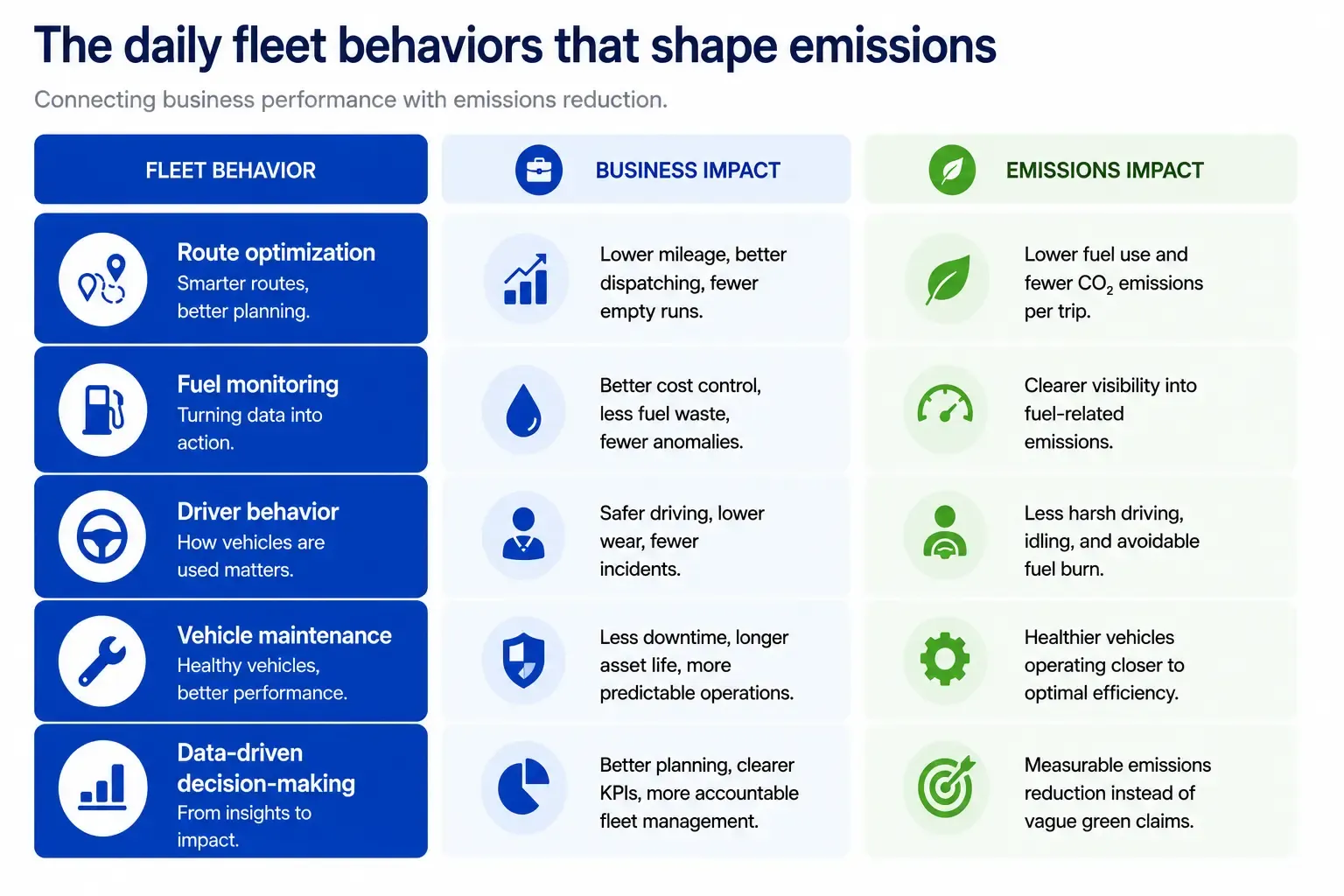 How fleet operations affect costs and emissions
The transport industry is under growing pressure from rising operating costs, regulatory requirements, and ESG expectations. As a result, sustainability often needs to prove its practical value before it can become a fully developed strategic priority.
Wialon as an example: carbon accounting powered by telematics data
The most visible connection between telematics and emissions is measurement. Platforms developed by telematics software providers, such as Wialon, can collect fuel consumption, mileage, and engine-hour data and use it as a basis for calculating Scope 1 emissions.
This means this data can then be converted into CO₂e emissions using the relevant emissions factors.
The less obvious – and arguably more valuable – role of telematics begins when the operational factors that directly shape fuel consumption: driver behavior, idling patterns, route inefficiencies, and vehicle maintenance issues are treated as an interconnected system in which each factor can be measured separately and assessed collectively.
These give companies the visibility they need to understand what can realistically be improved to get the results they want. For example, by using the Wialon Driver app to assess driving quality and detect violations, a fleet operator can compare harsh acceleration, braking, speeding, and idling with actual fuel consumption data, determine whether smoother driving is associated with lower fuel use, and translate that operational improvement into a measurable reduction in emissions.
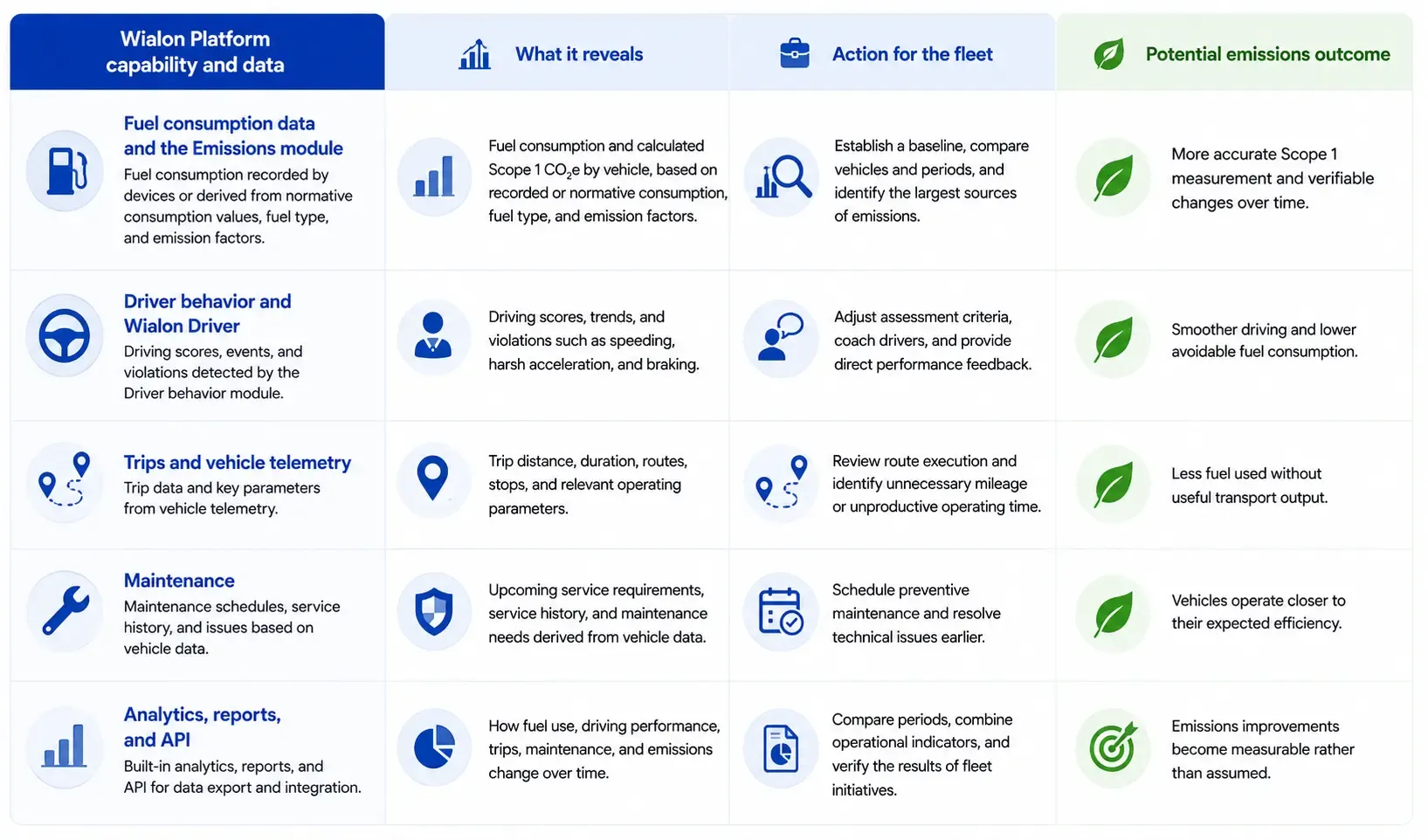
From Wialon data to emissions reduction
This is why fleets should not stop at the most obvious layer – measuring fuel use and converting it into CO₂e. The table below shows how different types of fleet data can reveal the causes of avoidable fuel use, guide operational improvements, and support measurable emissions reduction.
Where the limitations of telematics lie
Telematics is not a substitute for fleet renewal, electric vehicle adoption, alternative fuels, charging or fueling infrastructure, or the organizational changes required to support a long-term sustainability strategy. Nor does the usage of a telematics platform guarantee that emissions will fall: poor-quality data, incorrectly calibrated sensors, inconsistent vehicle configurations, or a lack of management follow-through can leave even a sophisticated dashboard without any practical effect. That means the data only creates value when it is reliable, interpreted in context, and connected to a clear operational response.
What telematics can definitely do is make the transition to greener transportation more manageable. It shows where the company stands today, where avoidable waste occurs, and whether the introduced changes are producing results.
Making sustainability operational at Gurtam
As a global GPS software company, Gurtam supports ESG (environmental, social, and governance) principles both in how we operate and through the value our products deliver to transport companies.
Gurtam’s software solutions create the connection between sustainability ambitions and daily fleet management. We provide tools to monitor fuel consumption and CO₂e emissions, improve driving behavior, optimize routes and vehicle utilization, plan maintenance more effectively, and build solutions for areas such as responsible waste management.
The goal is to turn operational activity into measurable data, help translate that data into decisions, and provide a way to verify whether those decisions are working. This approach is the bridge that makes sustainability operational.