Large-scale B2B SaaS partnership models usually rely on dedicated partnership teams in the company, structured enablement programs, and separate support and sales functions. These models work in their context; for example, the Wialon partnership approach is built around equal partnerships, different engagement models at different stages of growth, and clear functional separation between the teams involved.
But what should a smaller team do? Small engineering teams behind high-tech products often lack this structure. And in many cases, they do not need it. At Gurtam, we have a vision and an opportunity to build a tailored partnership approach for each product, Wialon, flespi, or GPS-Trace, based on its specifics and the team behind it, and make it work.
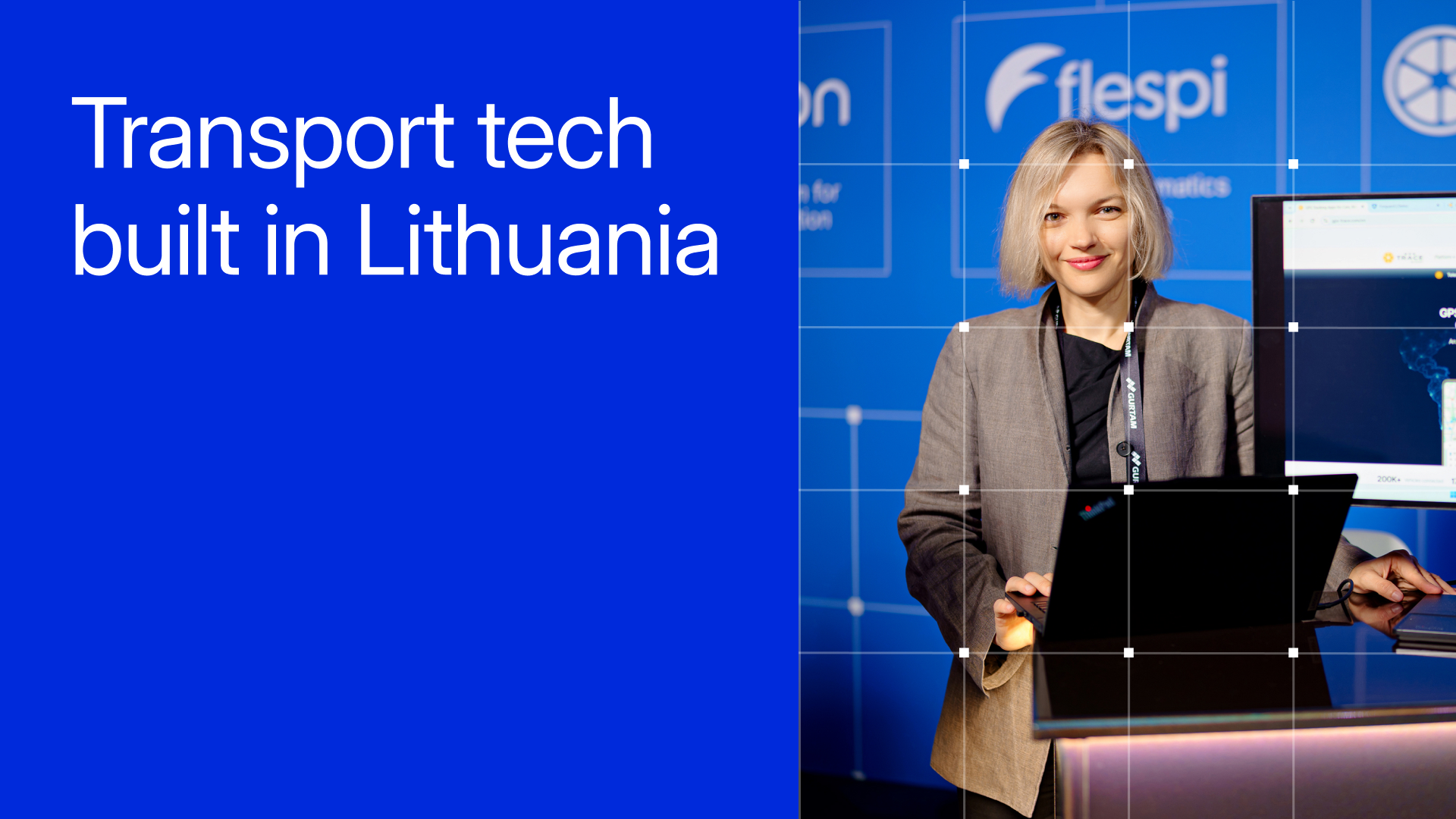
flespi is positioned differently within the telematics ecosystem. It is a deeply technical backend platform built for engineers and system integrators, rather than a broad commercial audience. Developed and supported by a team of 10 engineers and one marketing lead, it naturally prioritizes product development.
In this context, the partnership model cannot be copied from a larger organization. It has to reflect the team's structure and the product's nature. So how do you manage partnerships when the team is small and engineering-focused?
When support, sales, and partnerships development do not exist as separate functions
In small technical teams, communication cannot be divided into clear functional layers. The same request may include technical clarification, integration guidance, and pre-sales discussion, or an invoicing request. Splitting this across different roles would only slow things down.
Before the AI assistant was introduced, communication in flespi scaled linearly with human effort. Every new partner, every new integration, every new configuration request required direct involvement from engineers.
By the end of 2023, the number of responses had exceeded 5,000 per quarter, indicating the team was manually handling more than 1,000 messages per month.
In this setup, the team’s capacity to respond becomes the bottleneck, which directly impacts acquisition. Scaling B2B SaaS partnerships without solving the communication problem is simply not realistic.
A structural solution was required. This is where AI came in.
Historically, technical support in our team is organized in a rather non-traditional way: there are no dedicated support specialists; instead, each (or almost each) flespi engineer is on duty in client support chat one day per week. We call this being a dispatcher.
From my experience, such support days used to be quite "tough": the number of clients grew, platform functionality became more diverse, and the clients' questions were getting more and more complex and time-consuming.
And what made it even more challenging, we had a policy of providing support in real time mode - in live chat, rather than via emails with delayed posts. This meant that we were supposed to (almost) immediately respond to incoming requests from clients, which forced a dispatcher to frequently switch between different questions and was very exhausting.

Nadzeya Mikhailava, Developer, flespi team
codi as a structural shift, not a tool
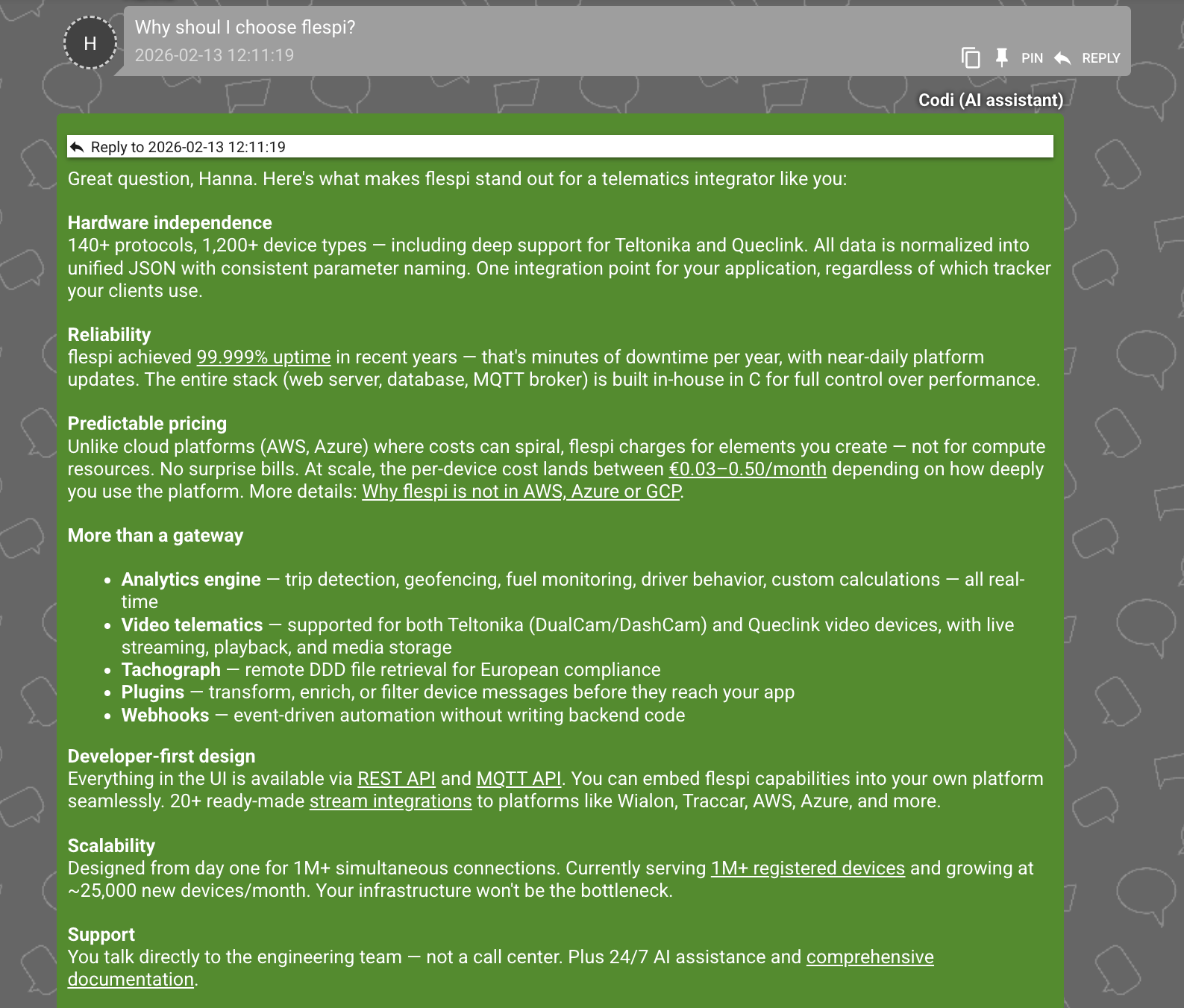
In early 2024, the flespi team introduced codi, its AI assistant, designed to offload the team from standard repetitive requests. Initially, codi handled basic technical support. Gradually, it absorbed partner-related questions, as well as sales, invoicing, and marketing communication.
In Q1 2024, codi handled around 26% of incoming requests. Today, around 90% of all communication is processed by AI. For partners, this translates into shorter response times and the ability to resolve issues without waiting for human availability.
Today's partners interact with codi when:
-
submitting a new partnership request,
-
asking for help with advanced configuration,
-
clarifying integration details,
-
requesting marketing information.
At first, some partners were skeptical of AI’s capabilities. Over time, trust grew. Fewer and fewer questions were escalated to engineers.
First, codi is always ready to respond to a client at any time of the day or night, and now it's codi who operates in "chat" mode in flespi support: humans don't need to switch to each new incoming communication, losing context, time, and distracting attention. In my opinion, this is the main brain-saving change. Second, codi patiently and politely communicates with any person (and in any language!) and never loses its temper. And this is really heart-saving change.
Third, codi is now capable (thanks to lots of tools he equipped it with) that it really prepares full-fledged reports on clients' issues, saving our time (and eyes!) on viewing logs, configurations, device messages, documentations, etc. Sometimes it's amazing how thoroughly it has studied the issue, checked everything, and found a needle in a haystack.
Nadzeya Mikhailava, Developer, flespi team
At a certain point, codi effectively began to perform part of the role traditionally handled by a partnership manager. It became the first point of contact, the source of guidance, and the coordinator of routine interactions.
The fact that the AI assistant is available 24/7 and communicates in the partner’s language also makes a difference.
Let’s look at codi in practice.
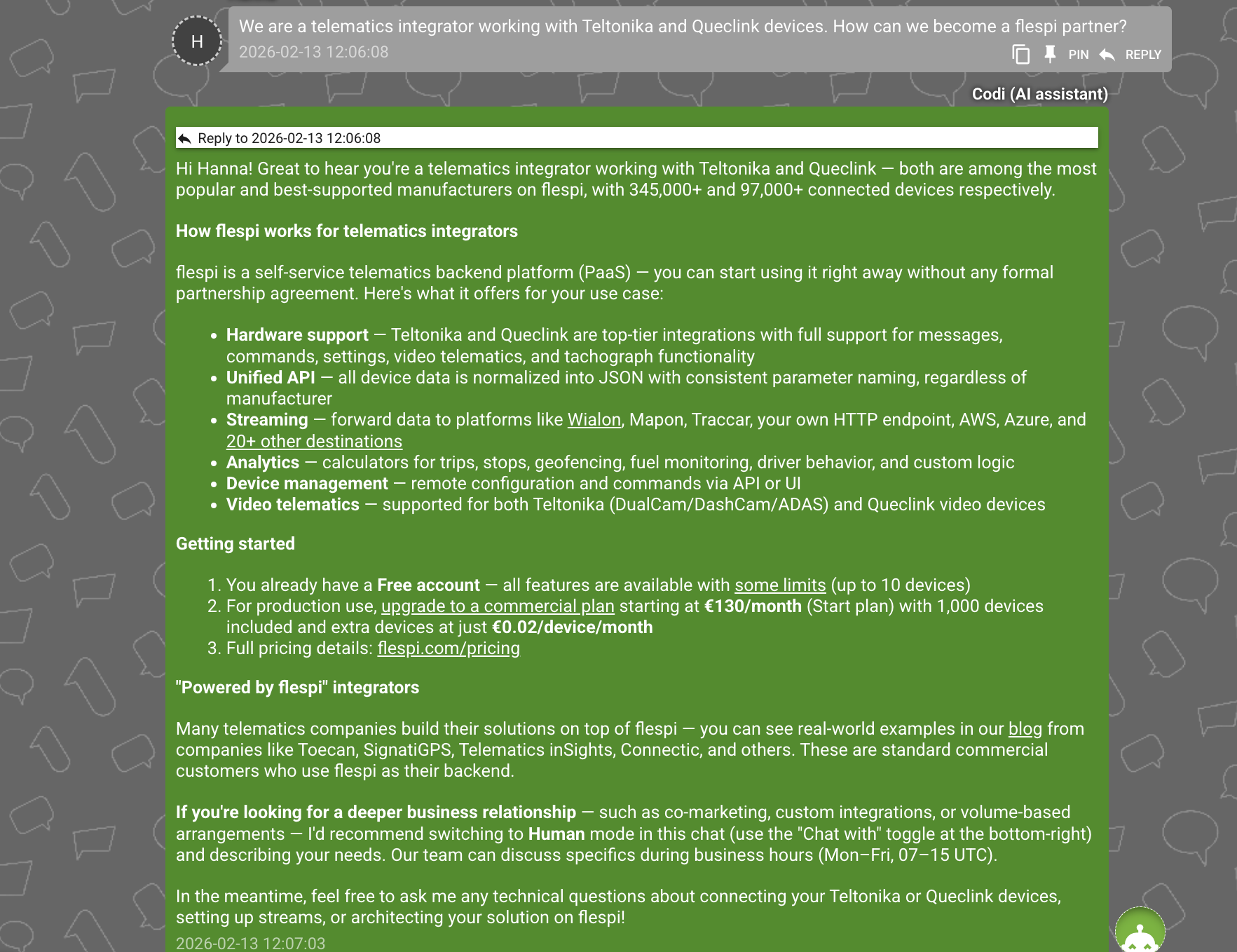
First communication
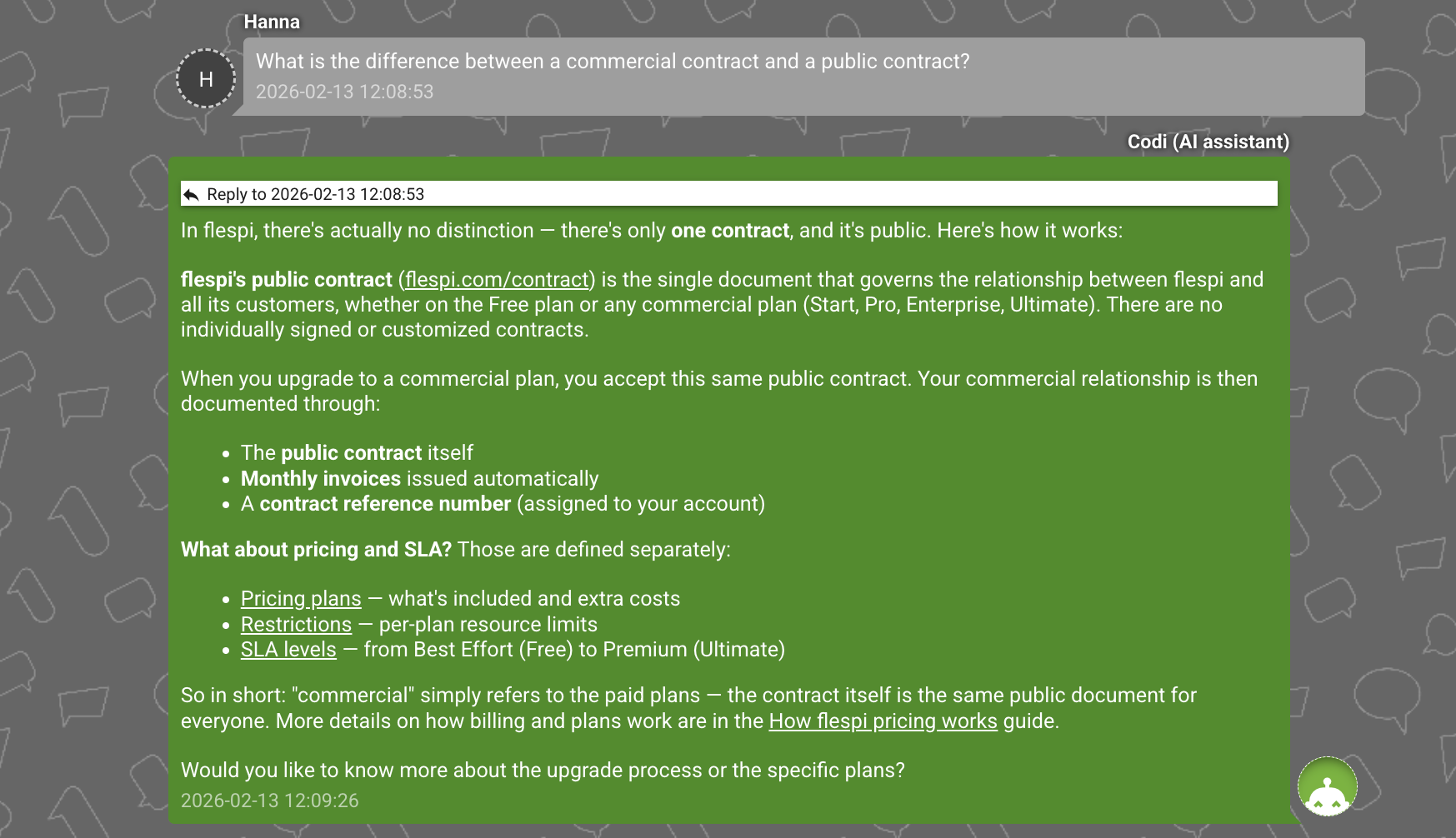
Commercial request
Certain cases still require direct involvement from engineers. Partners know there is a real team behind the product. This human presence remains an important part of communication.
What changes when AI becomes the main communication layer with partners
codi operates continuously and across contexts. It isn’t a support chatbot bolted onto existing processes; it lives inside the operational layer and participates in the same work the team does. For partners, this means that instead of being redirected between departments, they work through a single interaction layer that can analyze context and respond immediately.
One of the first real use cases codi took over was the automation of device configuration and onboarding into the product catalog. flespi is hardware-agnostic: it supports hundreds of devices and protocols, and historically, the team handled these requests manually by inspecting device specifications, parsing logs, and updating protocol support one case at a time. For partners, this change meant faster onboarding of new devices.
With codi in place, many of the routine but complex tasks are now automated and used by engineers as well. And this is only one operational area where codi turned communication from a human bottleneck into infrastructure.
And once communication becomes infrastructure, the way partnerships are managed changes as well. Partnership ceases to be a function and becomes a property of the system.
With AI in the loop, we can now deliver an almost flawless onboarding experience. I wouldn’t say codi directly drives sales or generates leads, but it plays a crucial supporting role. The focus has shifted toward increasing loyalty and significantly reducing churn. AI helps customers quickly understand the product, shortens time-to-value, and reduces the risk of drop-off.

Andrei Ambrazevich, VP of Marketing, flespi team
The cost of treating partnerships as architecture
Treating partnerships as part of the system architecture, as is done at flespi, comes at a cost. It affects both revenue and expenses.
On the revenue side, the impact became visible over time. Although the model was not designed for aggressive partner expansion, its operational effect was reflected in commercial metrics. In 2025, quarterly commercial device registrations were more than twice as high as in the pre-AI period. The partnership structure itself did not change. What changed was the system’s ability to process demand.
On the cost side, AI usage grows over time. At scale, commercial deployment of large language models comes with significant operational costs, including model usage, infrastructure, and supporting systems.
The second cost is operational effort. A system like this does not run on autopilot. Models need to be selected and tested, instructions require constant refinement, knowledge bases must be updated and structured, and tools need to be added and maintained; all of this is required to keep partner communication consistent and reliable, and more than that, trustworthy. AI does not remove work, but it changes the type of work.
Finally, this practice is not universal. It works in highly technical environments where communication is structured and data-driven. In relationship-heavy or sales-driven partnership models, it would not deliver the same results.
At flespi, partnership is not managed as a separate function. It is designed into the architecture. This may sound unusual in a business context, but for a technical platform it is a natural extension of product thinking. If communication is part of the system, then partnership becomes part of the system as well.
The chosen partnership structure reflects long-term product thinking within a technical B2B SaaS platform. It is not built around short-term growth metrics, but around sustainability and operational coherence.
Today, we’re no longer aggressively hunting for new clients; instead, most of the competition happens directly in the chat. That’s where decisions are shaped, questions are resolved, and relationships are strengthened.
Andrei Ambrazevich, VP of Marketing, flespi team