In 2026, it would be fair to admit that the days of software companies releasing cool products and capturing market share at breakneck speed are over.
In today's competitive environment, long-term success for B2B SaaS vendors depends not just on product quality but also on how deeply their platforms are integrated into clients’ daily operations and strategic goals. It’s not about selling licences and providing access anymore; it's business support on the level of operational integration.
At the core of this approach is the understanding that businesses are never at the same level of need, and that their current stage should define the collaboration model. Understanding these shifts is often the difference between partnerships that plateau and those that continue to grow.
The question, then, is how to identify these stages and respond to them effectively. To do so, Gurtam regularly conducts global research, gathering structured feedback from partners across regions, experience levels, and stages of cooperation.
At the end of 2025, the Wialon team conducted a CSAT survey (a standardized methodology used to measure satisfaction with products, services, and overall cooperation), which allows them to look beyond individual cases and see broader patterns: what partners value most at different points in their journey, how priorities shift over time, and which aspects of cooperation become more or less important as partnerships mature.
Below, we break down the main conclusions and explore how they play out in practice.
Stage-based evolution of partner expectations
Based on an analysis of related CSAT characteristics, we can distinguish 4 partner groups within the Wialon ecosystem, each reflecting a different stage of partnership development. The number of such groups and their internal characteristics may vary across companies and industries, largely depending on the average customer lifecycle. In practice, the midpoint of your customer lifecycle helps define where the maturity stage falls on the timeline.
In the case of Wialon, we have:
- Stage 1: Newcomers (<6 months – 1 year)
- Stage 2: Establishing partners (1–3 years)
- Stage 3: Maturity partners(3–5 years)
- Stage 4: Experienced partners (5+ years)
Each group is characterized by a distinct set of traits that shape its expectations toward the service provider and strategic priorities for the business.
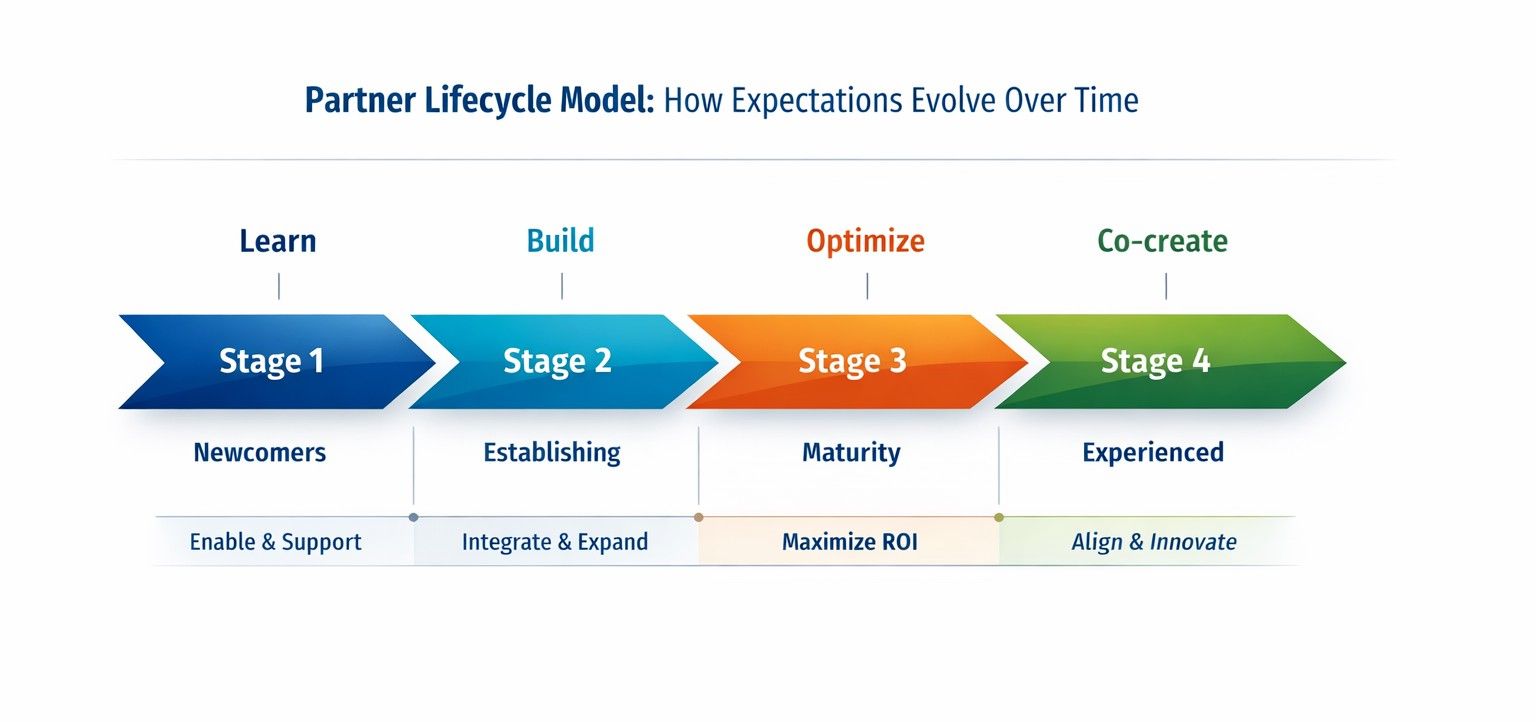
Stage 1: Newcomers (<6 months – 1 year)
At the early stage of cooperation, newcomers rely heavily on training and technical support as they navigate a high level of uncertainty and build initial expertise. In the telematics industry, this process is often slowed by high barriers to market entry and can take up to a year, compared to around 4 months in many other industries. Newcomers' expectations center on quick, simple, and clear solutions that help them move forward, while commercial terms typically play a secondary role at this point.
Among partners working with Wialon for less than six months, business assistance is a key factor for 17% of respondents, compared to an average of 6% among more experienced partners. For partners with 6–12 months of experience, technical support is critical for 22% of respondents, after which its importance gradually decreases.
At this stage, partnership development is primarily driven by product guidance and by familiarizing partners with where and how they can access information. From the manager’s perspective, the key task is to gain an initial understanding of the partner’s business, which serves as a foundation for future growth.

Olga Galai, Partner Success Manager
New partners are primarily focused on basic operational needs and quick results, such as account setup, understanding how Wialon works, and receiving prompt, hands-on support.
As a result, their requests are mostly related to core product fundamentals: system stability, clear logic, and user-friendly interfaces. In communication with new partners, clarity and consistency are essential to building trust.
Stage 2: Establishing partners (1–3 years)
At the establishing stage, partners move from learning the platform to actively building and scaling solutions on top of it. Having mastered the core technology, they focus on launching projects, extending functionality, and integrating Wialon into broader system architectures.
This group shows the highest interest in integrations (11%), reflecting a shift from learning the product to building additional solutions on top of the platform.
This stage is reflecting a shift from “how the platform works” to “what can be built with it.” While technical support remains important, business development assistance becomes less central as partners gain confidence and autonomy.

Elizaveta Zhankevich, Partner Success Manager
As partners mature, they naturally gain a wealth of experience and knowledge. Developing them may require more creativity and the ability to address high-level requests.
Stage 3: Maturity partners (3–5 years)
The midpoint of the partnership lifecycle is often a turning point: partnerships either adapt to new expectations or slowly drift into inertia. It marks a transition from expansion to optimization. Partners shift their focus at this point from building new solutions to improving efficiency, commercial performance, and long-term predictability.
At the maturity stage, expectations toward service quality and speed rise, while pricing and commercial terms gain greater importance, reflecting a more strategic and results-oriented approach to cooperation.
Growth often stabilizes, pricing and commercial terms become central to the partnership, as mature partners evaluate cooperation through the lens of measurable ROI and operational efficiency.

Pavel Izotov, Partner Success Manager
As a partner’s business matures, their requests shift from routine operational support to comprehensive strategic collaboration. At this level, success is no longer about “how a feature works” – it’s about high-level business architecture. Meeting these advanced expectations requires a more sophisticated and qualitative approach. It is a completely different stage of business evolution, where our role shifts from being a technical provider to becoming a strategic catalyst and IoT & telematics adviser for their long-term growth.
Stage 4: Experienced partners (5+ years)
Experienced partners represent the most advanced stage of the partnership lifecycle. While the maturity stage is centered on efficiency and predictability, this stage is defined by long-term alignment, influence, and shared responsibility for sustainable growth. Partners at this level expect a partnership-driven approach based on experience, trust, and deep business alignment, with a focus on joint development rather than one-sided interaction.
Among experienced partners with more than five years of cooperation, priorities fully shift toward commercial efficiency and mature service delivery. Pricing and commercial terms play a key role for this group (19% — the highest among all segments), while expectations for technical and business support focus on speed, depth, and expert-level assistance, including a deep understanding of the partner’s business and operational processes.
Without this transition, even well-optimized partnerships risk stagnation as business needs evolve beyond existing collaboration models.
Pavel Izotov, Partner Success Manager
If we don't continuously innovate alongside our experienced partners, we won't be able to provide a modern, effective foundation for the Wialon business. Developing an expert partner isn't just about solving their current challenges: it’s about refining the very standards that keep the entire Wialon community competitive in 2026.
From stages to strategy: what supports long-term partnerships
Understanding how partner expectations evolve across stages, based on Wialon’s experience working with a global partner ecosystem, highlights several principles that help respond to the needs of such systems and remain effective in a complex SaaS environment.
-
Continuous proactive engagement
Effective partnership management goes beyond being available for questions. Regular check-ins and “health checks” of the business relationship help identify shifts in priorities early and allow both sides to adapt before challenges arise, rather than reacting after issues surface. -
Deep business immersion
Successful partnerships are built not only on product expertise, but on a deep understanding of a partner’s business model. Knowing whether a partner operates in heavy machinery, cold chain, logistics, or another domain enables more relevant guidance and avoids one-size-fits-all recommendations. -
Technological foresight
As partner expectations mature, so does the need to look ahead. Staying competitive requires not only mastering current telematics solutions, but also understanding emerging technologies from advanced analytics and AI-driven tools to machine learning and IoT data processing — that will shape the next stage of industry development.
Olga Galai, Partner Success Manager
For a Partner Success Manager, developing long-term partners requires strong business and strategic thinking, and the ability to balance partner advocacy with company goals, making this work more complex and nuanced.

Miguel Alejandro Pedroza Barra, Partner Success Manager
Over time, partners often place full trust in their manager’s guidance. Even when they are aware of higher-level decision-makers within Wialon, they usually see the manager not only as a messenger but as someone who can internally advocate for them, allowing them to focus on their own business with confidence. In many cases, for the partner, the manager is Wialon, so availability, professionalism, and competence must consistently meet that expectation.
Community and partner ecosystems in mature partnerships
Technical excellence and a solid understanding of a partner’s business are essential points in a partnership. However, as partnerships mature and reach Stage 3 and beyond, these factors alone may no longer be sufficient to sustain long-term collaboration.
From the very start, Gurtam has focused not only on software development and expertise growth, but also on creating a broader partner environment around Wialon, complementing technical and business alignment with additional forms of alliance.
The Wialon partner community provides a space where partners find inspiration, confidence, and opportunities for continued growth. It shifts communication from a closed vendor–partner model to an open ecosystem where partners can interact directly with each other, exchange experience, and build value collectively.
At the core of this ecosystem are our partner WhatsApp communities – the primary daily communication channel for partners. Beyond daily communication, we complement this continuous interaction with offline and hybrid formats such as Wialon community reunions, fleet management hubs, Wialon Challenge, “Open mic” webinars, and other partner events.
For mature partners, the community serves as a platform to influence product development, share deep expertise, and find reliable partners for large-scale joint initiatives.

Ekaterina Terekhova, Community Manager
Ultimately, the community transforms the “Wialon-to-partner” relationship into a partner-to-partner network, with Wialon acting as the connecting link. This creates a form of added value that is difficult to measure in reports, yet it forms the foundation of the strongest, most sustainable long-term partnerships.
Partnerships as evolving systems
Partnership development is not a linear process and rarely follows a single, universal model. Understanding partnership stages, as one approach, provides a practical framework for interpreting feedback, aligning expectations, and building more resilient collaboration models. In a mature SaaS environment, long-term success increasingly depends on the ability to see partnerships in motion — not as fixed relationships, but as evolving systems shaped by time, experience, and shared business realities.