Artificial intelligence (AI) is transforming business processes across industries: from software development to customer support. Yet for many companies, AI still feels more like an experiment than a practical tool.
At Gurtam the journey with AI began cautiously. Today, however, AI has become an integral part of our customer support operations, helping teams work faster, provide more accurate answers and focus on high-value tasks for partners around the world.
We spoke with Paulius Sabaliauskas, Vice President of Customer Service (Wialon), about his department's path from experimentation to real adoption, and what AI means for the future of technical support.

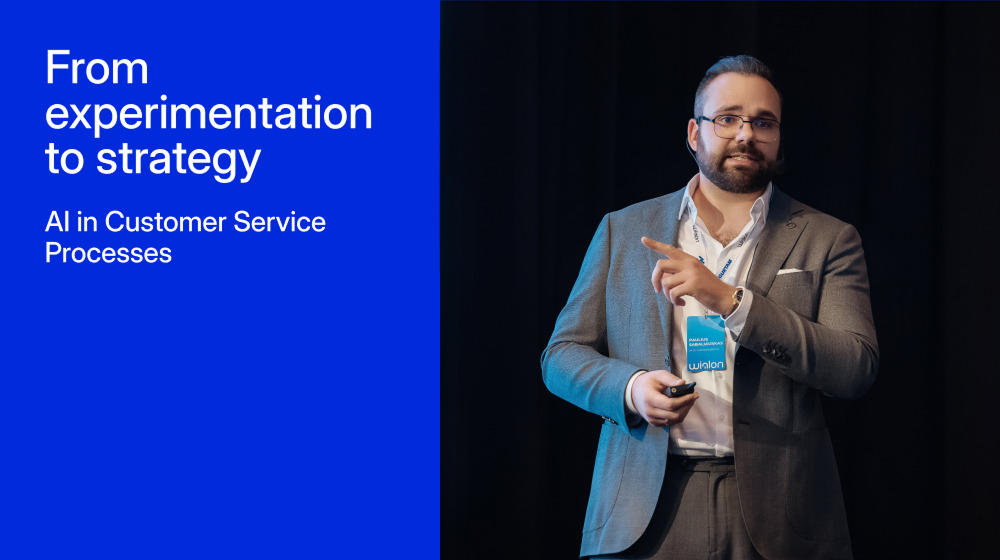
Paulius Sabaliauskas, VP of Customer Service
From experimentation to strategy
When Paulius first took leadership of the customer support department, introducing AI was one of his priorities. Looking back, he says the company would likely have moved faster if they had known how quickly the technology would evolve.
“Two years ago, AI in customer support was still in its early stages for us,” Paulius explains. “If I could go back, we would probably invest more aggressively — not only in tools, but also in educating our people about how to work with them.”
At the time, scepticism was widespread across departments, particularly among technical teams.
“Many engineers simply didn’t see AI as a practical tool for solving the technical issues they deal with every day,” he says. “For them, AI was mostly associated with chatbots — something that might answer basic questions, but not help with complex diagnostics.”
Because of this, his team initially approached AI cautiously.
“We were experimenting rather than implementing. We tested different tools, ran small pilots and observed what worked and what didn’t. It wasn’t yet a top priority — more an area we were exploring because we saw signals from the market that AI would become important, especially in customer support.”
The turning point
The early experiments produced mixed reactions. While some employees recognised the potential of AI tools, others experienced their limitations firsthand.
“The first users who experimented with AI were quite optimistic,” Paulius says. “But the teams that had to rely on those tools saw that they were far from perfect.”
In some cases, early AI tools created more confusion than clarity.
“They disrupted existing processes. People felt that instead of simplifying work, they sometimes complicated it,” he recalls. What eventually changed the perception was a combination of internal champions and visible results.
A key influence was the company’s founder, Aliaksei Shchurko, who actively encouraged experimentation with AI.
Gurtam Founder and CEO A. Shchurko (left)
“That leadership support played an important role,” Paulius notes. “It inspired many people in the customer support team to explore the technology themselves.”
Gradually, a community began to form across departments.
“People started sharing discoveries — articles they read, new large language models they tested, improvements they noticed. AI became a common interest connecting colleagues who previously didn’t collaborate closely.”
Through this organic exchange of knowledge, AI adoption accelerated.
“Over time, AI simply became part of our daily workflow.”
Turning support processes into structured systems
Customer support in the telematics industry is highly technical and often mission-critical. With millions of vehicles connected to the platform, support engineers must diagnose issues quickly and accurately.
“Customer support work is actually very methodical,” P. Sabaliauskas explains. “Partners usually come to us with problems. When you analyse thousands of these cases, patterns begin to emerge.”
“Pattern solving can become processes and later can be broken down into smaller tasks,” he says. “Some of them are easy to automate, others are more complex. The key is choosing the right tools and connecting them into a logical sequence.”
Experienced engineers often solve problems intuitively based on years of experience.
“But when you want AI to replicate that process, you must describe every step explicitly,” Paulius explains.
In practice, AI in technical support does not need creativity.
“What it really needs is the ability to find the right information from the right sources and interpret it correctly.”
From answering questions to analysing real data
Early AI tools used in support relied mainly on static information sources such as help-centre articles or documentation.
Today, the next stage of development allows AI to work directly with real partner data.
To enable this, Gurtam introduced integrations through Model Context Protocol (MCP) tools, which allow AI systems to access relevant internal data securely.
“With MCP tools, AI can check platform configurations, analyse the situation in a specific account and identify where the problem might be — whether it’s a device issue, connectivity problem or incorrect platform settings.”
This capability significantly expands the role AI can play in diagnostics. Instead of simply suggesting possible causes, AI can now investigate real scenarios and assist engineers in identifying solutions much faster.
Key achievements so far
One of the fastest and most visible benefits of AI in customer support has been multilingual communication. The company can now provide 24/7 support across multiple languages.
“Our partners work in dozens of countries,” Sabaliauskas says. “AI allows us to communicate naturally in almost any language.”
However, this required significant preparation because Wialon has its own specialised terminology.
“We had to teach the AI how specific terms should be used in different languages,” he explains.
The result is a major improvement in communication efficiency.
“A support engineer in Lithuania who speaks Lithuanian and English can now easily reply to customers in French or Spanish — and the response will sound natural and technologically correct.”
Another important achievement is AI’s ability to analyse real customer data and deliver highly relevant answers within seconds.
But Paulius emphasises that the biggest transformation may actually be cultural.
“We now have a group of people in customer support who actively explore AI technologies, test new tools and contribute to developing them.”
In many ways, the support team is evolving toward a hybrid role.
“You could say we are slowly developing ‘AI CS engineers’ within customer support.”
Will AI eliminate junior roles?
One of the broader questions surrounding AI adoption is its impact on workforce development. If AI can perform many different tasks, will junior specialists still be needed?
Paulius believes the answer is more nuanced.
“AI can automate a large portion of routine work, but final decisions will still remain in the hands of experts,” he says.
Even if the number of entry-level roles decreases, organisations must maintain strong expertise within their teams.
“These experts are the ones who design, supervise and improve AI systems.”
He describes AI as a tool that helps teams to do more impactful work.
“It removes repetitive tasks and allows people to focus on activities that create the most value.”
Simply reducing headcount because of AI would be short-sighted.
“If five out of ten employees become less busy because AI handles part of their work, the easiest solution would be to let them go,” he says.
However, according to Paulius, companies can redirect that expertise into new initiatives such as partner education, consulting or training. New areas of work will emerge, and these will also require junior specialists.
“Direct human interaction will always remain highly valued in business. In the age of AI, its importance may actually increase.”
Ultimately, AI’s role is not to replace expertise, but to amplify it.
According to Paulius, “It removes a large share of repetitive work and allows our team to focus on solving complex problems and creating value for our partners.”